
Where should a monthly budget start?
A budget built from guesses tends to fail in the first week, usually in the category you guessed lowest. A budget built from a month of real records starts from where you are, so every limit is a change you chose rather than a number you hoped for.
If you do not have that month yet, record one first. How to find out where your money goes sets that up in five steps. It costs a month, and it saves the three months of false starts that usually come before a budget that works.
1. Separate fixed costs from flexible ones
Fixed costs are the same, or nearly the same, every month: rent, bills, phone, a transport pass, subscriptions. You change them by making a decision once, such as moving, switching provider or cancelling, not by trying harder this month.
Flexible costs move with your choices: groceries, eating out, fuel, clothes, entertainment. This is where a monthly limit does its work.
Yearly costs hide in between. Car insurance, a domain name or an annual membership are fixed, but they land in one month and wreck it. Divide each by twelve and budget for it every month.
2. Give each category a limit
Here is a worked budget built from one real month. The flexible limits are cuts, but the total also has to cover the insurance and the birthdays that last month did not have:
| Category | Kind | Last month | Monthly limit |
|---|---|---|---|
| Rent | Fixed | 850 | 850 |
| Bills | Fixed | 154 | 160 |
| Phone | Fixed | 20 | 20 |
| Transport pass | Fixed | 45 | 45 |
| Subscriptions | Fixed | 30 | 30 |
| Car insurance, 540 a year | Fixed | 0 | 45 |
| Groceries | Flexible | 480 | 420 |
| Eating out | Flexible | 310 | 180 |
| Fuel | Flexible | 190 | 200 |
| Clothes | Flexible | 160 | 100 |
| Entertainment | Flexible | 130 | 90 |
| Health | Flexible | 35 | 60 |
| Gifts | Flexible | 0 | 50 |
| Other | Flexible | 150 | 250 |
| Total | 2,554 | 2,500 |
The total is only 54 below last month, yet eating out alone is cut by 130. The difference pays for things last month skipped: 45 a month toward the insurance, 50 for gifts, and a larger Other line as a buffer for the broken phone screen nobody plans for.
Two rules make limits stick. Cut the category that surprised you most, not every category a little. And leave Health and Other with room to spare, because a budget that punishes a pharmacy visit gets abandoned.
3. Add it up to one number
Fourteen category limits are too many to check while standing at a till. One monthly total is easy: 2,500 in the example. Check the total during the month, and look at the categories behind it when the total starts running fast.
A weekly figure helps between checks. 2,500 split over four weeks is 625 a week. Most months are slightly longer than four weeks, so treat 625 as a ceiling rather than a target.
4. Check it during the month
A budget you read on the 31st is a report. Read it on the 10th and the 20th and it is still a plan. Look at what is left, compare it with the days left, and if one category is already near its limit, slow that one down rather than everything.
Setting it up in WhereItWent
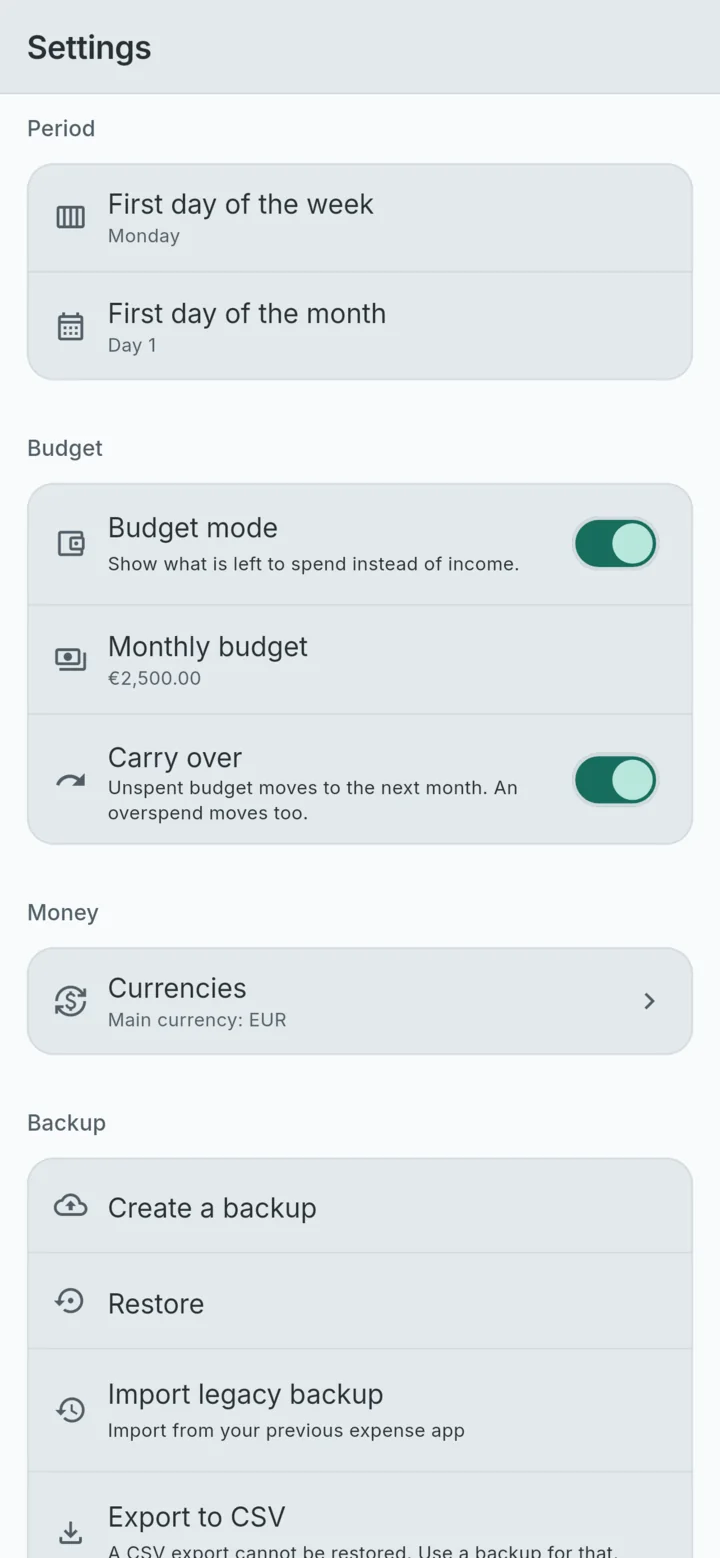
In Settings, turn on Budget mode and enter your Monthly budget. If you are paid on the 25th, set First day of the month to 25 in the same screen, and every budget month runs payday to payday.
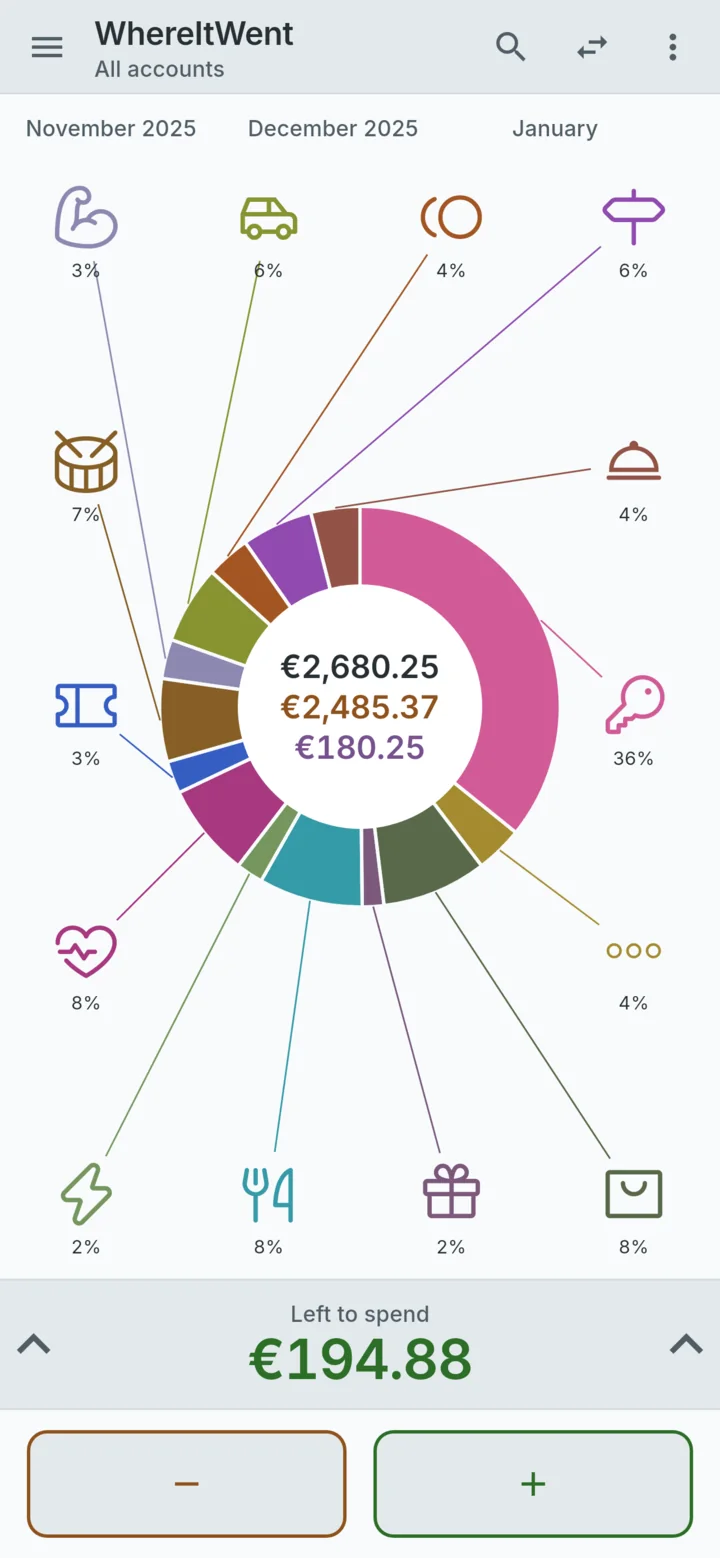
The bar at the bottom of the dashboard then reads Left to spend instead of the balance, and it counts down as you log. The middle of the ring shows what the month can spend, what is spent, and what was carried over. Switch the period to a week and the budget scales to a quarter of the monthly figure. Income still appears in your records, but it never raises the limit: a payday does not make the month's spending allowance any bigger.
WhereItWent tracks one monthly total, not a separate limit for each category. Keep the category limits from step 2 in your plan, and check them on the ring. Hold a category and its total for the month appears in the middle, ready to compare with its limit.
What happens to the leftovers
With Carry over on, what you did not spend moves into the next month, and so does an overspend. Here is how it plays out on a 2,500 budget, starting from the first month with any records:
| Month | Carried over | Can spend | Spent | Left |
|---|---|---|---|---|
| 1 | 0 | 2,500 | 2,320 | 180 |
| 2 | 180 | 2,680 | 2,610 | 70 |
| 3 | 70 | 2,570 | 2,700 | −130 |
| 4 | −130 | 2,370 |
An overspend is a debt to yourself, not a fresh start, which keeps the budget honest over a whole year. The dashboard below shows the same arithmetic with real cents: 180.25 carried over, 2,680.25 to spend, 2,485.37 spent and 194.88 left.
Things to know before you rely on it
- Budget mode applies to All accounts. When the dashboard is narrowed to a single account, it shows that account's figures and the budget steps aside.
- Carry-over counts from your first record, using today's budget for every month since. If you have a long history from before you budgeted, the carried amount can be large. Turning carry-over off gives every month a clean start.
- The budget is in your main currency. Spending in other currencies is converted into it at your own exchange rates.
Fixed costs are easiest to budget when they are already in the ledger before the month starts. How to track recurring bills and subscriptions covers entering them once so each month shows them in advance.
WhereItWent shows what is left to spend this month, and can carry the leftovers into the next one. Free, offline, no account, no ads.
Get WhereItWent